Category Archives: beautiful buildings

Floral Depot ~ Fantastique!

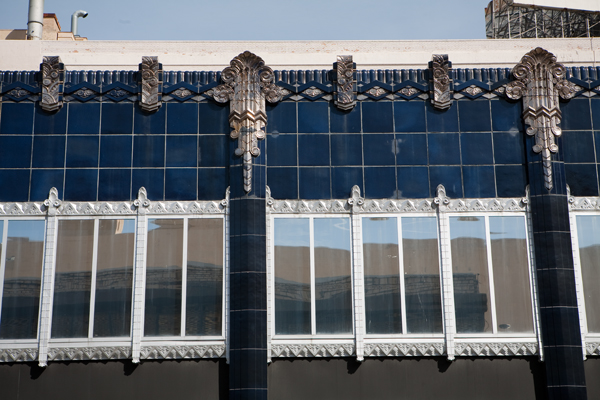
Here’s another stunner… the Floral Depot Building at Telegraph and 18th, just across the street from, and in late afternoon literally in the shadow of, the mighty Fox Theater. Also clad in terra cotta – both the cobalt blue tiling and silver ornamentation, comprising Aztec-style trim interjected with periodic “sprays” of silver reputedly designed to resemble waterfalls – this Art Deco beauty is one of Oakland’s finest. The City’s Cultural Heritage Survey cites it as an “outstanding architectural example of extreme historical importance.” I dub her the crown jewel of Oakland, the resemblance unmistakable to me.

terra cotta ornamentation, floral depot building, flora restaurant oakland

terra cotta ornamentation, floral depot building, flora restaurant oakland, oakland art deco buildings

floral depot building, flora restaurant oakland, uptown nightclub oakland art deco buildings

terra cotta ornamentation, floral depot building, flora restaurant oakland, oakland art deco buildings

Designed by architect Albert Avers and built in 1931, the building takes its name from the old Floral Depot once housed there. See original sign below (image borrowed courtesy of DougPants.org), followed by the renovated sign for my favorite restaurant in all of the East Bay, the incredible Flora, opened in late 2007 by the proprietors of the highly successful Doña Tomas in Temescal.

floral depot building, Oakland Floral Depot Building

Oakland Floral Depot Building, flora restaurant oakland

Thomas Schnetz and Dona Savitsky took a chance on this stretch of Telegraph well before the grand re-opening of the Fox that many hail as the beginning of Uptown’s resurgence.  I would argue that the opening of their prohibition-era-inspired Flora marks the beginning instead, becoming a “symbolic anchor” in an area clearly in transition, “much like San Francisco’s Zuni Cafe did when it opened more than 25 years ago on what was then a depressing stretch of Market Street.” (Flora paves the way… by Michael Bauer)

I’ve written about Flora before in my first post on Art Murmur (First Friday Frolic! ~ ART MURMUR), and I’m sure I’ll write about it again because it’s just that good. I don’t care if it makes me sound like an arugula-munching, latte-sipping liberal. The food & drinks here are simply divine… classic American fare with a California-nouveau twist, inspired by the best seasonal & organic ingredients. Make a reservation, or get there early for a seat at the bar… watching the suspendered-bartenders work their magic is half the fun.

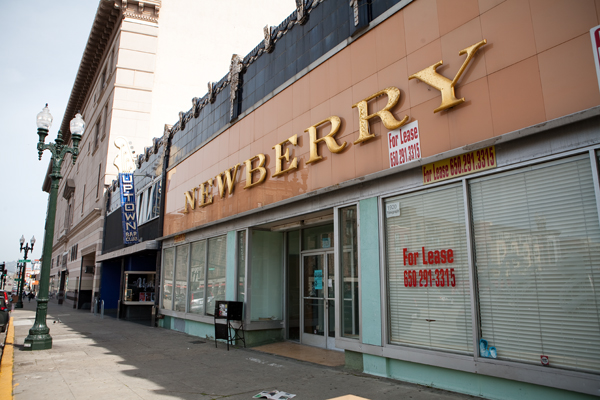
But let’s get back to the building… Other early residents of this building include the J.J. Newbury Department Store, a nationwide five-and-dime chain prevalent during the 20th century. Now closed and available for lease, the old logo still remains…

floral depot building, JJ newbury oakland, uptown nightclub, oakland art deco buildings

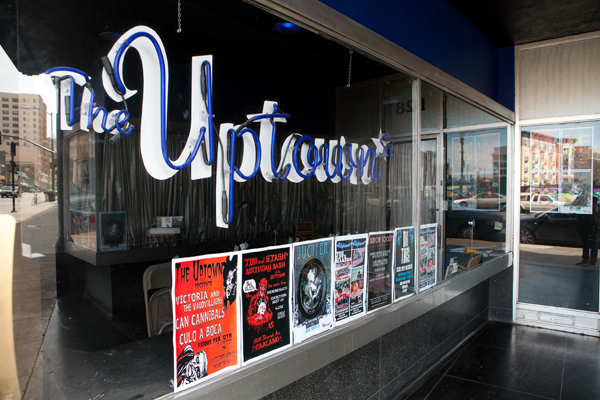
Next door, you’ll see the Uptown Nightclub, also opened in late 2007. Embarrassingly, I have yet to see a show here, but they get great props on Yelp, and I’m planning a visit next week in celebration of Women’s History Month. They’re hosting two nights of The Vagina Monologues by Eve Ensler, a benefit fundraiser for her organization V-Day which, to date, has raised something like $50 million dollars in support of groups working to ending violence against women and girls worldwide.  Woah. Please join me, or check out the Uptown’s Calendar for other cool shows…

floral depot building, uptown nightclub oakland, art deco building

Art Deco & Terra Cotta

I am displaying my naiveté here, but I always thought that terra cotta was that fired earthen-colored clay they made cactus planters out of… cheap and not very pretty.  But as I delve into more of the architecture of Oakland, “terra cotta” continues to pop up in unexpected places. Unquestioningly, I’ve referenced it in posts on:

And today’s building features terra cotta like you’ve never seen it!  Just look at this…

Mary Bowles Building, Oakland Art Deco Building, Blue-green Terracotta

So what’s the deal with this terra cotta stuff?

Well, to begin, my first statement was essentially correct.  Terra cotta (or terracotta, or terra-cotta) is Italian for “baked earth.”  Yes!  It’s basically a clay-based material that can be molded in any variety of ways while “raw,” to be later heated to its final ceramic state in a kiln, or in ancient times on a hearth or by the sun.  The material has been used for centuries in art, pottery, water pipes, bricks, roofing tiles, and architectural embellishments. While the color can vary widely, everything from yellow to gray to pink (which explains some of the references above), the more common clays contain iron which produces the orange or reddish hue.  And like our simple cactus planters, the finished product is light, relatively strong, and somewhat porous, which makes it non-waterproof unless glazed.

For architectural decoration, terra cotta has advantages over other materials such as marble or stone sculpture, being lighter, cheaper, and able to be incorporated into series production using mold-making techniques, similar to cast plaster (we’ll get to this in my upcoming post on the Paramount). Though early architectural applications used the unglazed material, later developments incorporated glazing, both for protection from the elements, and to allow for greater variety of finishes, including faux metal patinas, and gorgeous coloring as in our lovely blue-green example above from one of Oakland’s Art Deco lovelies.

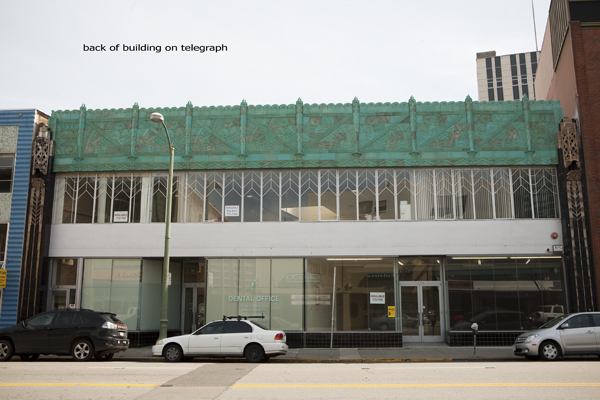
Built in 1931, designed by Douglas Dacre Stone, and later restored in 2004, the Mary A. Bowles Building is located on Broadway at 17th near where Telegraph and Broadway unite. The building spans the block, its backside on Telegraph just as pretty as the front.

Mary A. Bowles Building, Oakland Art Deco Buildings, Terra Cotta Frieze

Mary A. Bowles Building, Oakland Art Deco Buildings, Blue Green terracotta

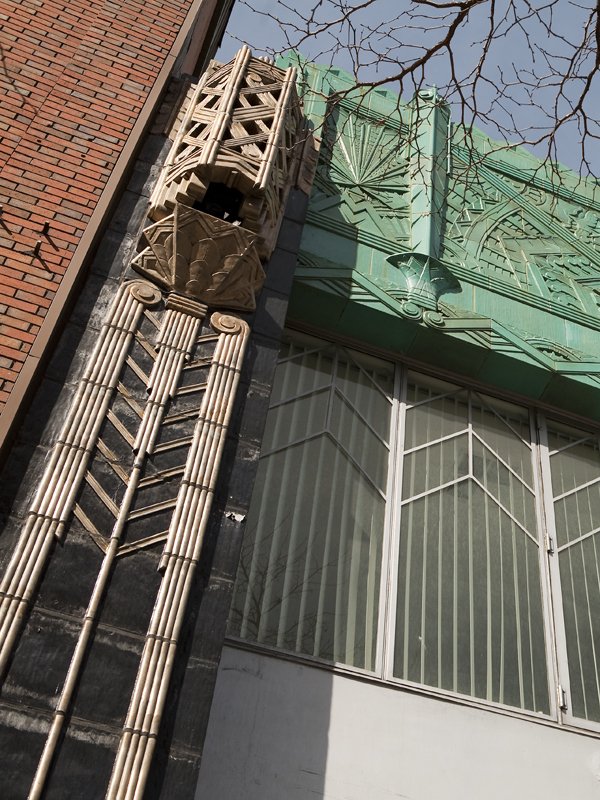
The terra cotta panels with their repeating swirls of organic shapes and sunburst patterns, as well as the geometric zig-zag patterns on the windows below are classic Deco. Check out the detailing on the metallic flourishes at each end… also likely molded terra cotta with a faux silver finish (similar to the Floral Depot building which we’ll also get to in coming days).

terra cotta ornamentation, oakland art deco building

terra cotta ornamentation, art deco buildings oakland

One more…
Art Deco Oakland Building, building designed by Douglas Dacre Stone

I was unable to find any information on Ms. Bowles and why she might have this building named after her, but I did find this obituary for her husband. If anyone has more information, please send my way…

Philip Ernest Bowles, Mary A. Bowles

What is Art Deco?

Art Deco was an international design movement popular in the 1920’s and 30’s, focused on themes of luxury, technology, modernization, and craftsmanship. The movement was born in Paris, an outgrowth of the previous Art Nouveau movement that was declining in popularity at the turn of the 20th century.

Art Nouveau (French for “new art”) focused on the importance of artisan craftsmanship, and typically featured organic motifs of flowers & plants, and/or highly stylized curved forms. Art Deco retains many of the same inherent aesthetic qualities as Art Nouveau, but was considered a modernization of the style, and until a comprehensive book was written about it, following an exhibition at the Minneapolis Institute of Arts in 1971 by Bevis Hillier, Art Deco had often been referred to as “Style Moderne.”

Hillier’s book was titled Art Deco of the 20s and 30s, which first popularized the term. He took his title from an exposition held in France in 1925, the Exposition Internationale des Arts Décoratifs et Industriels Modernes (truncating the words “Arts Décoratifs”). The Exposition was organized by a collective of French artists known as La Société des Artistes Décorateurs (the society of the decorator artists), and its purpose was to demonstrate French artists’ and designers’ dominance as leaders in the world of luxury design. The French are not known for their modesty!  The exposition was originally slated for 1915, but was postposted due to WWI, which had the unlikely effect of expanding the historical influences to the designs presented.

With the increasing ability to travel abroad, and international interest in archeology fueled by discoveries such as the lost city of Pompeii and King Tutankhamun’s intact tomb, artist and designers began incorporating exotic cultures and primitive arts into their design themes. These influences are pervasive throughout the Art Deco movement – Egyptian motifs are prevalent, as well as Grec0-Roman, Babylonian, Azteca, etc. and can be seen in sunburst and zig-zag patterns, staggered tiered/pyramidal structures, pictorial representations and more.

This period of Deco, sometimes referred to as Zigzag Moderne, flourished during the hey day of the post-war roaring 20’s. The economy was booming, people were optimistic, and the lavish yet modern stylings of Deco ushered in this age. Classic examples can be seen in the Empire State Building (pictured below) and Chrysler Building, both built in the late 1920’s in New York.

art deco architecture, empire state building, sunburst pattern, staggered pyramid

As I mentioned last week, I took the tour this past weekend of our incredible Paramount Theatre, “one of the finest examples of Art Deco in the United States,” which displays many of the Zigzag influences as well as references to Art Nouveau, through repetitious use of organic themes of grass, flower, leaf, & vine. I’ll be posting about it later this week, but it’s a lot of material to compose (the Paramount’s website alone has more than 4 pages of history and artists information, so I may need to break it up a bit). We’ll see… Please stay tuned.

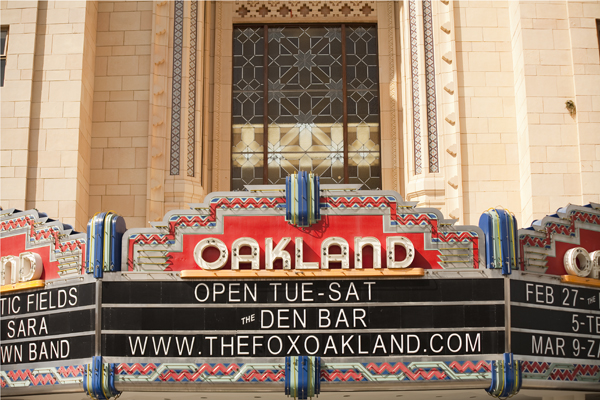
As Deco continued to develop throughout the 1930’s more industrial influences can be seen, such as sleek, aerodynamic stylings often referred to as Streamline or Streamline Moderne. Rounded corners, chrome surfaces, and the conveyance of speed influenced everything from buildings to cars to kitchen appliances. The renovated marquee of the Fox Oakland Theater (shown in my last post) is a good example of Streamline design, as is the 1934 Chrysler Airflow pictured below (photo courtesy of Randy Stern on Flickr).

art deco moderne, chrysler airflow 1934

Though a dominant design form through the early 1930’s, Art Deco waned in popularity mid-decade as the Great Depression continued to take its toll. The glitzy elegance and luxurious treatments of Deco-inspired buildings and products were seen as stark reminders of a promised prosperity, never realized. “Moreover, as the threat of a second world war loomed closer and closer, Art Deco was looked upon ever more vehemently. And with the outbreak of WWII in 1939, Art Deco was dead.” (Art Deco Style)

Not truly dead however… Because we have our wonderful historical homages to this period, many of which have been spared the wrecking ball due to their incredible beauty and craftsmanship. I’ll be looking at many of our Oakland Art Deco masterpieces in my coming posts…

What’s Moorish, Indian, Medieval, and Baghdadian?

Stumped?

(I bet you didn’t even know Baghdadian was a word… I didn’t!)

These are just a handful of the architectural influences of our majestic and recently refurbished Fox Theater. I’m kicking off my Art Deco series with the Fox despite its lack of Deco authenticity (we’ll get to more of what that means next week), because frankly, it’s kind of a big deal. And here’s why…

On Sept. 21, 1926 the Oakland Tribune reported “Oakland is to have two new motion picture theaters in the downtown district increasing the assessed valuation of the city by four million dollars or more…” The first of these was The Fox.
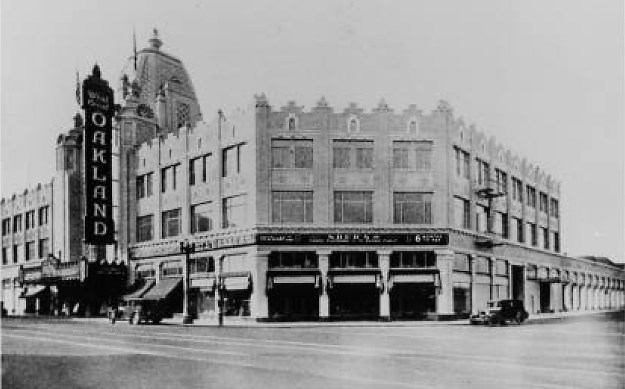
fox theater historical photo, fox theater circa 1928

Historical Photo circa 1928 (courtesy Dreyfus Report, 2001)

Originally called the Oakland Theater (or West Coast Oakland Theater) upon opening in 1928, the name was later changed to the Fox Oakland Theater, and at the time it was said to be the largest theater complex on the West Coast, with a capacity of between 3200 and 3800. This was the heyday of large movie “palaces,” dripping with atmosphere and ambiance designed to transport audiences to romantic and exciting distant worlds. “Persian gardens, Italian palazzos and Egyptian courts rose in cities throughout the country offering patrons an exotic afternoon or evening of entertainment.” (Dreyfus Report, 2001)

The architects of the Fox followed suit, drawing influences from a number of exotic cultures, most prominently Indian and Middle Eastern. In fact, the overall structure of the building, with its central high dome, resembles a typical Brahmanian temple of Northern India, and the interior auditorium space is flanked by two enormous sculptures of Hindu Gods. The entire theater was constructed to convey a lavish lifestyle, opulent with exotic woods, richly textured fabrics, jeweled light fixtures, intricate tile and plaster work, and highly decorative metal finishes.

Moorish architecture is “a term used to describe the articulated Islamic architecture which developed in North Africa and south-western Europe.” (Wikipedia) This influence is seen in the parapet (elevated wall) connecting the two primary pylons comprising the main facade of the building, as well as the continuing roof-line of the main commercial wings of the building, with its repeating pattern of terra cotta ornamentation, and distinctive key-hole windows (see below).
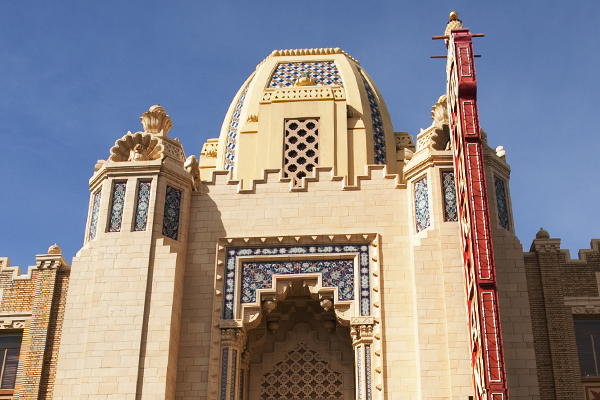
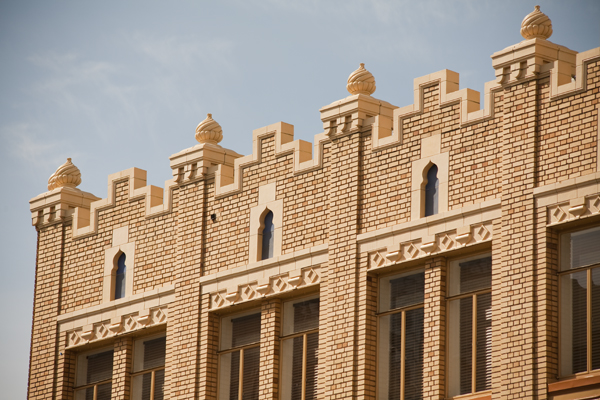
moorish architecture, fox theater oakland

moorish architecture, fox theater oakland

The medieval influence can be seen in the gargoyles perched atop the primary pylons (below, right).
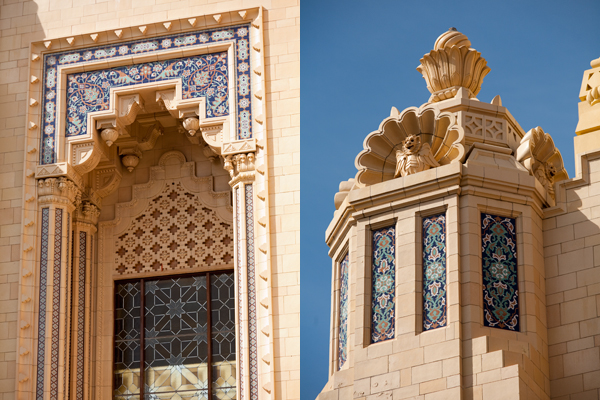
gothic architecture, moorish architecture, fox theater oakland

And I’m not quite sure how the Baghdadian comes into play, other than the initial plans to call the theater “The Baghdad,” before settling upon the eponymous “Oakland Theater” instead.

So where’s the Art Deco you might ask?

Well… to be honest, there’s not a whole lot. But there is a bit, much of which was added during modernizing renovations in 1945. “The front façade and interior walls [were] covered with stainless steel sheathing in an art deco style zigzag pattern. The columns [were] sheathed in a streamlined stainless steel shape and the ticket booth replaced with a new one in the art deco style. The original tile floor [was] replaced with terrazzo, and the ceilings replaced by a stepped plaster ceiling in a cloud pattern, with neon accents… While these alterations represent fine examples of the art deco style, they resulted in the loss of a substantial amount of very significant historic material, and are inconsistent with the architectural character of the theater.” (Dreyfus Report, 2001)
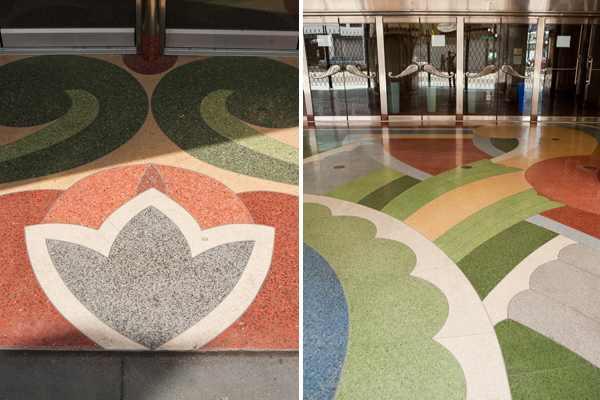
Art Deco Terrazzo, fox theater oakland, terrazzo inlay

The marquee was also updated to a more modern art deco style, but was done 10 years prior and is, hence, considered to be a “contributing historic” element. Here’s a shot of the original marquee followed by its replacement in 1935 (now refurbished).
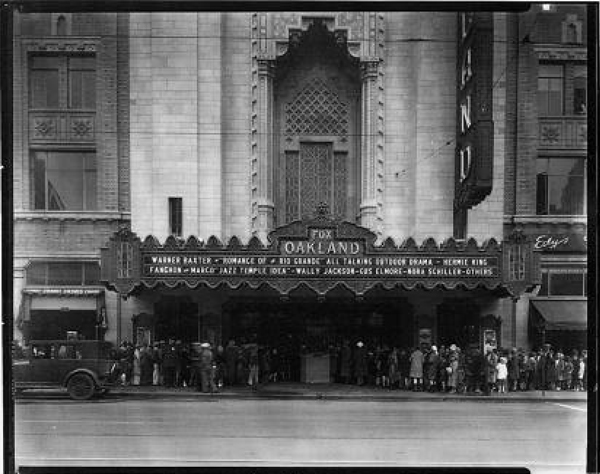
fox theater oakland, historical photo fox theater

Original Marqee circa 1929 (courtesy Dreyfus report, 2001)
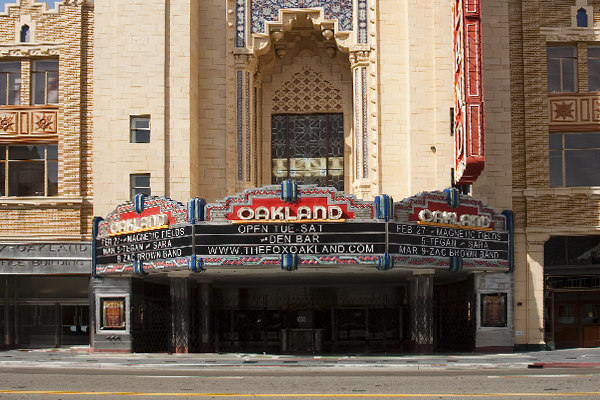
art deco theater marquee, fox oakland marquee

art deco, fox theater oakland, art deco theater marquee

The Fox was a premiere entertainment destination for decades, but suffered a decline in attendance in the 1960’s, as did many of the grand movie palaces throughout the country, due largely to the increasing popularity of television and the trend toward smaller multiplex theaters. The Fox tried several options including showing soft-core porn movies such as “Paradisio,” but eventually closed its doors in 1965, opening only sporadically for films and events during the next seven years.

“The Fox survived an arson fire in 1973, but its increasingly shabby condition led it to be derided as ‘the largest outdoor urinal in the world.‘” Still, the theater avoided being turned into a parking lot in 1975, unlike its sister Fox Theater in San Francisco, leveled in 1963 to make way for eventual replacement by high-rise offices and apartments. And thanks to the efforts of Oakland Mayor Lionel J. Wilson, the Fox Oakland achieved city landmark status in 1978.

And then it sat. And sat. And sat. It changed hands a few times and saw a few sporadic performances, but for the most part it simply sat… and continued to deteriorate. The City of Oakland purchased it in 1996 for $3 million dollars. In 1998 an Oakland Tribune editorial declared “the only life in the theater almost two years [after the City’s acquisition] is a crop of mushrooms sprouting from the theater’s soggy carpet.”

Then things started to happen. In 1999, the city spent $1 million to repair the roofs. At the same time, a sub-committee of the Oakland Heritage Alliance was formed, Friends of the Oakland Fox. Their goal: the historic preservation of the Fox Oakland Theater, and its use as a live entertainment venue. The Friends convinced the city to spend more money to restore the marquee and vertical blade sign to generate public interest in the renovation plans. And finally, architectural consultants Hardy Holzman Pfeiffer Associates were contracted to prepare a master plan for the Fox, generating two proposals that were both ultimately deemed undoable.

This is when Phil Tagami stepped in. He is the man who spoke before thousands at last year’s Uptown Unveiled block party to celebrate the re-opening of the Fox and the revitalization of Uptown. He is the hero of this story, the man who ultimately achieved what many said couldn’t be done. And can you guess what he did? Of course you can. The man raised money. And a lot of it. With a background in construction and prior experience restoring old buildings (including Kahn’s department store across from City Hall), he fashioned together a complex funding plan from various sources: private donations, city redevelopment money, grants, federal historic tax credits, large equity investments, and more.

An Oakland native, Tagami essentially donated thousands of hours of his personal time… his gift to the city, where he still lives with his wife and two children. Thank you Phil Tagami! We owe you a huge debt of gratitude.

And thanks as well to the City of Oakland, Friends of the Oakland Fox, and all those involved in this historic project.

The Fox Oakland Theater reopened on February 5th, 2009. Shows are currently booked by Another Planet Entertainment, the same folks who bring wonderful eclectic shows to the Independent in San Francisco. If you haven’t yet seen a show at the Fox, it’s high-time you high-tailed it to Uptown Oakland to check out this incredible gem!
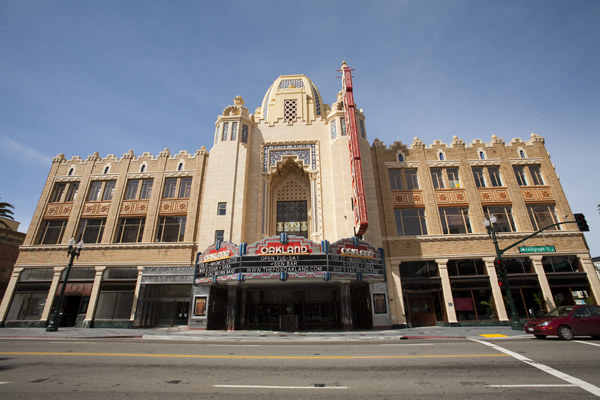
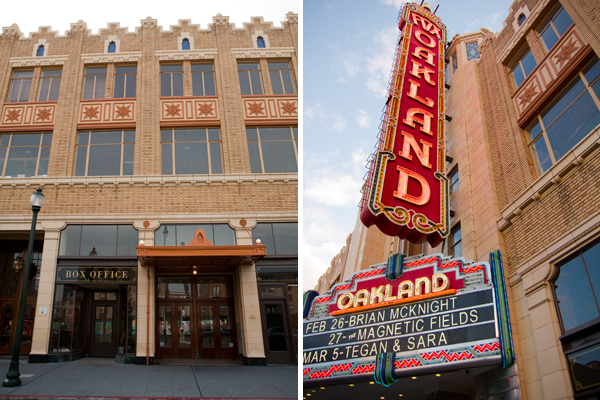
fox theater oakland, fox theater box office, fox theater marqee