Category Archives: beautiful buildings

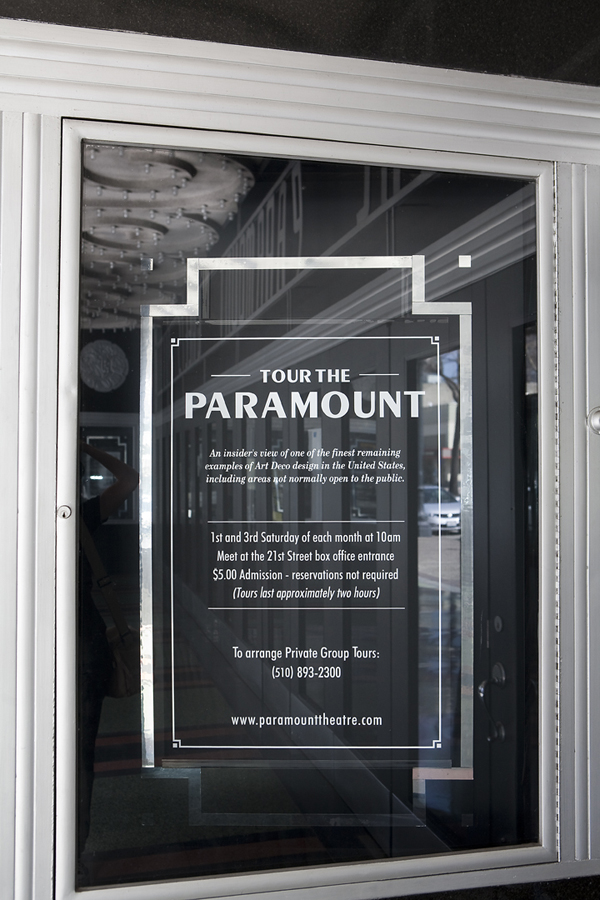
Touring the Paramount…

ART DECO DAYS – intro

In my early days in the Bay Area, I used to usher a lot of shows. I ushered shows in San Francisco at the Warfield, the Fillmore, and Bimbos; theater performances at the Berkeley Rep; and concerts at the Paramount Theatre in Oakland. Ushering allowed me to see a lot of shows for free, which is great when you’re young, broke, and don’t mind standing on your feet all night.

The Paramount ushering gig was the strictest of all… not only did you have to wear nearly black-tie attire, but you were required to attend one of their bi-monthly tours to learn the history of the building prior to your first gig, so if perchance a paying ticket-holder asked you a question about the artistry, architecture or history of the venue, you’d be savvy enough to answer accurately.

I took my first tour of the Paramount nearly a decade ago, and if I remember correctly, we spent a great deal of time talking about the renovation of the Paramount, an Art Deco masterpiece built in 1931, refurbished and reopened in 1973. What I also remember about the tour, was a brief discussion of the Paramount’s neighbor, the Fox, a once grand movie palace that, at the time, had been sitting vacant and decrepit for over 30 years. Our tour guide told us that sadly, the Fox might never achieve its restoration as the Paramount had due to economic factors, being simply too expensive to repair in the 21st century.

Well, we all know now that my tour guide was, fortunately, mistaken. The Fox has been restored, but it was a long struggle indeed. We’ll talk more about the Fox tomorrow, and more about the Paramount and Art Deco in general next week. But let this be the official kick-off of my Art Deco Days series.

I’m touring the Paramount again this Saturday at 10am. It costs 5 bucks and is well worth it. I encourage folks to join me if interested…

paramount theatre oakland, paramount theater oakland, art deco theaters

Dave Chappelle played Oaktown!

Ok…  I’m backtracking a bit here, so no spoiler alert necessary… I’m sure everyone and their brother knows by now that Dave Chappelle played a great, relatively new (opened in October 2009), little club in Oaktown called The New Parish.  What folks may not know, is that I was lucky enough to see one of these shows.  Woo hoo!!

First, The New Parish at 18th and San Pablo.  It was called “Town Hall” prior to its new debut last fall, and apparently Dave made a super-secret appearance there in April of 2009 (his first appearance in Oakland since 1996)… not a bad notch to have on your belt.  Prior to its short-lived incarnation as Town Hall, the venue was known as Sweet Jimmie’s after its proprietor Jimmie Ward, who opened the club in 1990 (he had a previous location, opened in 1982, but it was damaged during the Loma Prieta earthquake).

“Sweet Jimmie” Ward died just a couple of weeks ago at the age of 74… I’m going to quote extensively from a blogpost I found about his passing (Sweet Jimmie Ward Dies – Aimee Allison | Oakland Seen) because his story fits neatly into the framework I discussed last week, of that first generation of Southern Blacks who came to Oakland in search of better opportunities, to leave their lasting marks on our city:

A former longshoreman, he was one of hundreds of thousands who came from the South to work at the shipyards or on the Army base during World War II and stayed to raise families and start businesses and shape neighborhoods. Ward made Sweet Jimmie’s into the place to go – dressed to the nines – where old soul from Mississippi and Louisiana and Georgia was alive.

Those in Sweet Jimmie’s generation brought small town manners and blues and political organizing and art. They created a legacy and culture in Oakland that defines us today. Now, Oakland’s black population has plummeted under the weight of unemployment and police sweeps and shady mortgages. But you can still see the storefront of the old Sweet Jimmie’s at 577 18th Street in downtown Oakland. Many people don’t know that for many years it was an important meeting place for African-American political and community organizations. It was a center of influence. And while many celebrate the remaking of culture and nightlife in the city, I am taking a moment to mourn what we lost. See, Sweet Jimmie’s wasn’t just another nightclub, Jimmie Ward just another nightclub owner. He represented an era here in Oakland. And that era is over.

While that era may be over, it is no secret that Sweet Jimmie’s nightclub suffered a decline in its later years.  There are some entertaining stories on YelpEven Dave Chappelle did a riff on this during his show, spoofing on the scene from Sixth Sense… “I see dead pimps… and they want me to do things for them!” The crowd roared in hilarity, because before the whole remaking of the Uptown district of Oakland, this little stretch of San Pablo was known to be hella-ghetto, to put it bluntly.

One era ends… another begins… and I am here to loudly celebrate the new era of The New Parish, Uptown, and Oakland at large.

But let’s get back to the show…

For those who don’t know (I didn’t know) Dave is known for his ridiculously long sets… My friend who went to the late show said she left at 4:15 am and Dave was still going strong! We went to the early show… Thank God!

While we lined up outside, we were told that Dave was across the street at the Piedmont Piano Company.  Doing what you might ask?  Well… I assume playing piano.  And if you’re gonna play piano, this is a pretty sweet spot indeed.
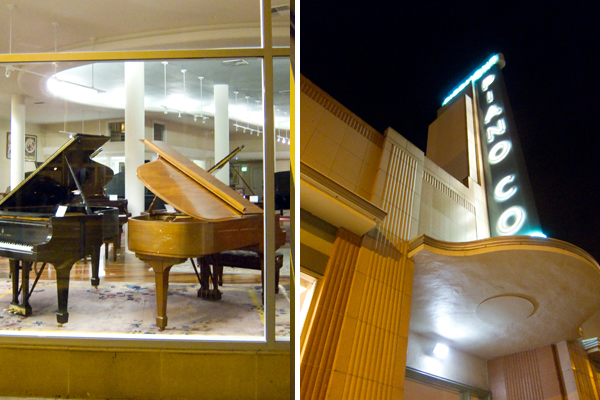
piano company, piano company on san pablo, uptown piano company

Housed in the historic California Furniture building, just one of dozens of Art Deco gems in downtown Oakland (stay tuned… I’m hoping to do a whole Art Deco series next month), the new location just opened a few weeks ago. They’re a family owned and operated business, providing not just new and used pianos for sale, but rentals, tuning services, music lessons (including guitar, drums, and more), and recitals. That’s right… they’re utilizing this gorgeous space for live performances too. Next performance is March 13th at 8:00pm Rebel Tumbao…  “merging Roots Reggae and Roots Afro-Latin vibrations with original compositions and wicked arrangements of Bob Marley’s music, all with a critical progressive social message for our times.”  Sounds pretty cool, eh?

But I digress…
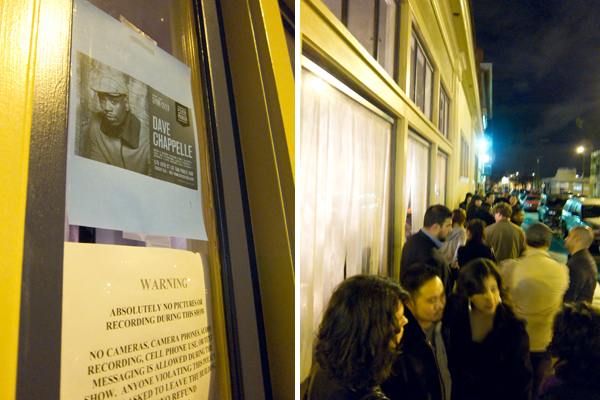
waiting in line, dave chappelle, new parish

As we waited in line, we chatted with all the folks who were equally excited to see Dave in such a small venue. I don’t know for sure but my guess would be that the Parish holds about 300 people. The line ran right past the windows of the new restaurant next door, Hibiscus, where Dave would later eat dinner after he tired of his piano playing. I heard from friends the drinks are good. We’ll have to check them out another day…

The Parish staff were ultra-professional and seriously buttoned-up. Notices were posted along the full length of the line about restrictions on photography, video, and most interestingly, heckling… “NO HECKLING WILL BE TOLERATED.” Who the hell would heckle Dave?! Anyway, despite all the notices, the doorman gave us the full verbal run-down as well… You can’t do this, you can’t do that, you will get thrown out. I asked, “Jeeezzz… Are we allowed to laugh?!” Absolutely. Enjoy the show.

new parish, oakland new parish, oakland music clubs

Above is the one and only picture I took inside, taken well before Dave took the stage… there was no way I was getting thrown out of that gig. It’s a pretty bad shot, but it gives you a feel for the space. I’ve been to one other show at the Parish and there was no seating as there was for this show (to enforce the two drink minimum). Typically there’s a nice dance area directly in front of the stage with wrap around areas on three sides and an upstairs with another bar and prime viewing from on-high.

What else can I tell you? Dave was hilarious. Of course. There was a ton of interplay between him and the crowd and I was surprised how conversational the show was… definitely not a scripted routine. The man is smart. And quick. Of course race played a big theme throughout the show, but not just black vs. white and not your stereotypical race-based humor. The crowd was incredibly diverse, as is our city, and Dave poked fun at all of us equally. The female scientist from Tunisia. The hipster Saudi with his trucker cap askew. And the hippy kids from Nevada who entered the club with backpacks in tow. I could try to replay the jokes, but I know they’d fall flat. I’ll just say we all laughed together, at each other, at ourselves, and for me, it was a truly transcendent experience. Props to The New Parish… Thank you!

African American Museum & Library

To commemorate the beginning of Black History Month, I made a visit to the African American Museum & Library on 14th Street, just a couple blocks behind City Center. I have to be honest, and I am ashamed to admit this, but this was my first ever visit to this museum which opened 8 years ago. I guess I’ll just say it was well worth the wait, because it really is a gem of an institution.

First of all, the building itself is absolutely gorgeous! Both an Oakland City Landmark, and listed on the National Register of Historic Places, it’s an architectural delight with lovely arched windows and doorways, detailed exterior stone work and incredible craftsmanship inside.

beautiful oakland building, oakland city landmark

The building was spear-headed by Charles S. Greene, Oakland’s City Librarian from 1889 to 1926, who realized the city was outgrowing its first public library (a wooden structure erected in 1878 where City Hall now stands). He initiated a campaign to build a new one and, along with others including a women’s organization called The Ebell Society, found funding assistance from Andrew Carnegie’s Foundation, which offered $50,000 for the construction of the building. It was designed by architects Bliss and Faville in the American Beaux Arts style, and served as Oakland’s main library from 1902 until 1951.

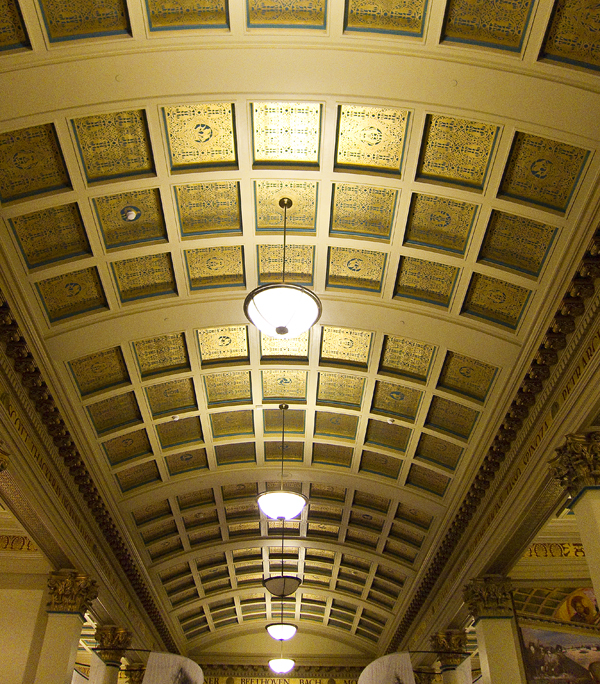
“The elegant exterior of tan brick and terra cotta is incised with names of authors and disciplines and “Oakland Public Library.” “Free to All” is inscribed above the main entrance. The interior exhibits elaborate oak paneling, classical columns, and ornamented plaster ceilings. The second floor with its coffered, barrel-vaulted ceiling supported by massive columns, is one of Oakland’s most imposing interior spaces.” [Historical Plaque co-sponsored by Oakland Heritage Alliance]

barrel-vaulted ceiling

Once the new main library (at 14th and Oak streets) was opened in 1951, this building served as a branch library, at which point it was renamed the Charles S. Greene Library. It later became city offices, and was eventually abandoned after the Loma Prieta earthquake in 1989. “Following extensive restoration, it reopened in 2002 as the new home of the African American Museum and Library at Oakland.”

The mission of the Museum & Library is to discover, preserve, interpret and share the historical and cultural experiences of African Americans in California and the West for present and future generations.

The library is housed downstairs and consists of unique archives and reference materials on the history of African Americans in Northern California. The reference library houses approximately 12,000 volumes whose subjects include “religion, the military, Martin Luther King Jr., Malcolm X, the Black Panther Party, Africa in relationship to the African-American experience, genealogy, and California history.” And the archives contain diaries of prominent African Americans, newspapers on microfilm, videos and oral histories, and much more.

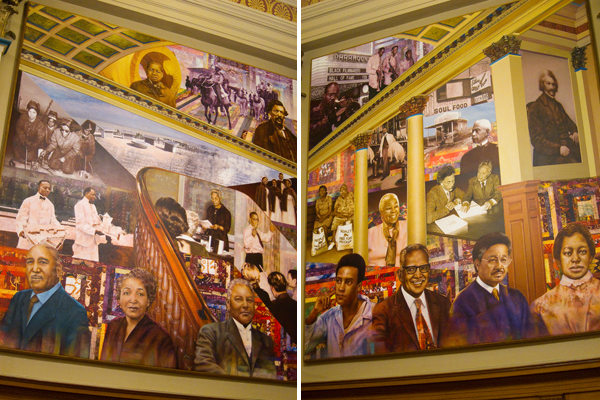
The museum is upstairs and “regularly hosts traveling and original exhibitions that highlight the art, history and culture of African Americans.” Here are two of the murals that greet you as you take the stairs to the second floor…

oakland murals, african american history, african american mural art

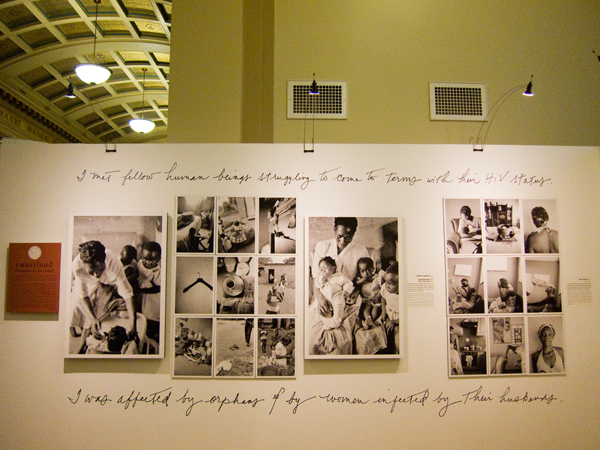
The current temporary exhibit is titled Access to Life: Faces from a Quiet Revolution and will be up through February 27th. It’s a powerful photographic exhibit by 8 Magnum photographers who focus their lenses on AIDS patients both before and for months following their antiretroviral treatments. “The project documents individuals in Haiti, Mali, Peru, Russia, Rwanda, South Africa, Swaziland, and Vietnam; countries chosen because of the diverse contexts and circumstances driving the epidemic in each one.” To learn more, visit accesstolife.theglobalfund.org. Here are a couple shots…

Access to Life, African American Museum

Access to Life, African American Museum, AIDS photo essays

There is also a permanent multi-media installation titled Visions Toward Tomorrow: The African American Community in Oakland, 1890-1990.Visions documents the historical accomplishments of generations of African Americans in Oakland from the era of pioneering and settlement to those eras of community formation, development of the press, establishment of local churches, and creation of a lasting legacy of music and the arts.”

If you’ve never visited this wonderful institution, might I suggest that there is no time like the present. In honor of Black History Month, I plan to focus on more African American cultural events and institutions as February continues…

The Alameda County Courthouse

So today I had to run a quick errand to the Courthouse… yea right!

All I can say is the entire experience was an incredible exercise in patience (I am not a patient person).

I like to consider myself a bit of a task-master (capable, efficient, etc.) I did my research. I knew where I needed to go. The document I downloaded from the internet directed me to my local courthouse – Wiley W. Manuel in West Oakland. I went there, waited in line, partially undressed to go through the metal detector and security screening, made my way to the second floor where I was supposed to find the Court Self-Help Center. Instead, I found a locked door with a PDF taped to the window stating that the self-help center had been moved. Mind you… this was the same PDF I had located on the internet and printed out, however the information here was different. Apparently no one bothered to update the web. Argh.

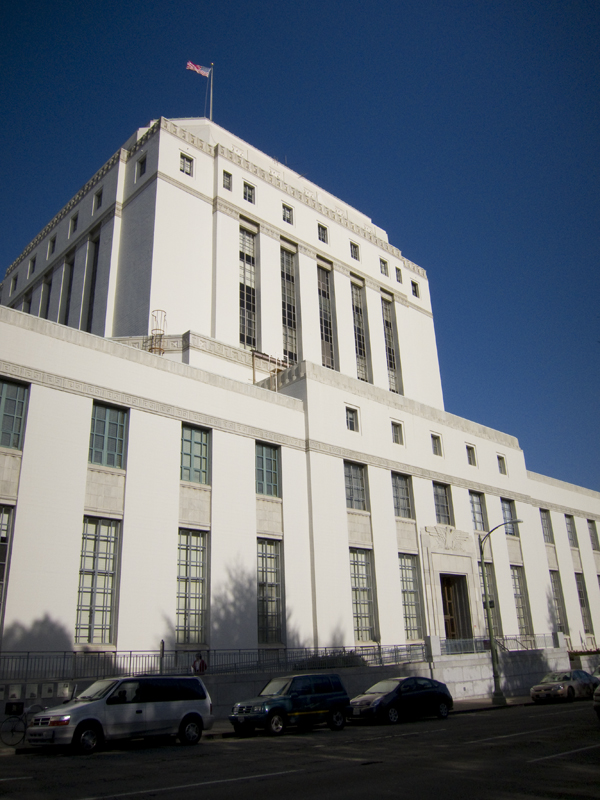
I then made my way to the correct location… the iconic Rene C. Davidson Courthouse, perched on the Southwest corner of Lake Merritt. Waited again in line, went through the metal detector and screening, made my way to the second floor… Room 240 where I expected to find the Court Self-Help Center. Instead I found a series of flyers stating that the Self-Help Center had been moved to the first floor, Room 109.

I could go on and on… two more lines, then directed to the basement, only to be told to go across the street to the Family Law Library, then back to the Courthouse, back through the security screening, back in line… You get my drift.

What should have been a simple 15 minute procedure took me 2 1/2 hours. Jeeezzzz…

The positive side is I got a nice look at this beautiful building, during a thin slice of blue sky and sunshine today. I refer to it as iconic because it’s frequently featured as an Oakland landmark in illustrated and photographic materials… like this vintage style postcard on Our Oakland’s Greetings From Oakland post. Which reminds me… did you all notice my new blogroll? Right-hand side… scroll down. Check it out, there’s some great stuff~!

Rene C. Davidson Courthouse, alameda county court

This is actually Alameda County’s Fifth Courthouse. The fourth was a real stunner, built in the Parisian Second Empire Style with a domed central tower and four miniature corner towers… see historical photo below. It was opened in 1875, located between 4th and 5th Streets at Broadway, and for over 50 years served “as a powerful symbol of the importance and wealth of what was then California’s fourth most populous county.” Sadly, it fell out of favor before the modern historic preservation movement and was ultimately replaced and eventually demolished. (Courthouse historical placard)

alameda county courthouse

Our current courthouse, the Rene C. Davidson, was constructed in the mid-1930’s through the passage of a $1.7 million bond measure, supplemented by Public Works Administration (PWA) funds. The building, consisting reinforced concrete over a steel frame, features exterior surfaces of California granite and terra cotta trim. Designed by prominent local architects William Corlett, Henry Minton, James Plachek, William Schirmer, and Carl Werner, the main facade of the building faces Lake Merritt (I actually shot the back from 12th Street) and opens to spacious lobby featuring fifteen foot high marble mosaic murals depicting county history. Wish I had pictures of those to share but I somehow missed seeing them while being funneled from line to line. Guess I’ll have to go back…