Category Archives: parks & gardens

It’s tulip time…

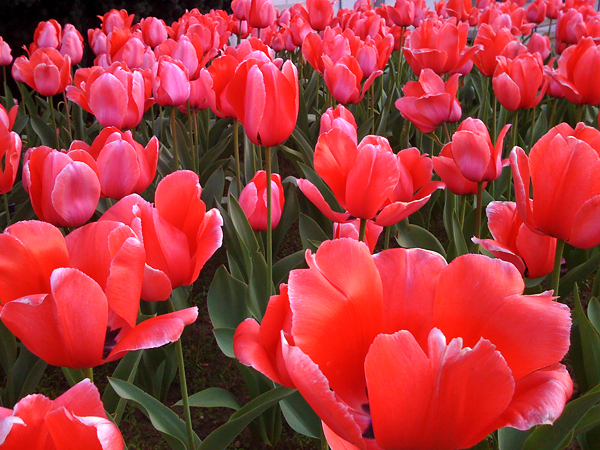
spring flowers, tulips blooming, mountain view cemetery, spring in oakland

I took a quick spin through one of my favorite places to walk in Oakland, Mountain View Cemetery, and realized it’s that time again… We’re still getting our share of rain (Sunday was a doozy) but plenty of warm sunshine too, and already the plum blossoms and daffodils have yielded to later blooming beauties, like the magnolias, wisteria, and these majestic reds. It’s a brief window… you gotta catch it when you can!

This got me to thinking that maybe I should focus on some of the gorgeous gardens in Oaktown, no doubt sprucing up under these longer warmer days for your viewing pleasure. Also, I’m working on a gardening series for Oakland Local, and Earth Day is coming up (lots of celebrations this weekend), so it seems right to focus on some greenery for a bit.

I’ve already written about some of my favorite gardens in Oakland:
Mountain View Cemetery
The Gardens at Lake Merritt (What is Art? and The Gardens Continued…)

More to come.  Please stay tuned…

A different kind of Flora…

No, I’m not raving about the amazing cocktails at the swanky Art Deco inspired Flora, again.  This is something different.

I know it’s not exactly Art. Unless you happen to view them as God’s Art.  I don’t personally subscribe to that belief, but I want to share a handful of the beauties the sun has recently coaxed forth in, what-is-soon-to-be, my new front yard. That’s right folks… I’m movin’ to the country!

Not really. Just a few exits down the freeway, and a little bit up the hill, and actually, not for a few months. But still in Oaktown, of course.

After a decade of sidewalk gardening and a parking space filled with potted cacti, I am incredibly excited to get my hands in some real earth. In fact, I’ll be writing a weekly column on Oakland Local about growing your own food, and my first post is up now. Please check it out if you’re green-thumbed like me…

oxalis flowers, oxalis weed, oxalis nightmare

This first one (above) is Oxalis. Considered a weed, and a nightmarishly difficult one to deal with at that, its flowers are really kind of pretty. I can appreciate them for now. But they should be forewarned… I will be diggin’ all those darned little bulbs up!

fuscia clustered flowers

I have no idea what this one is.  Looks like a nice snack for a hummingbird.  Anyone?

poppies, orange poppies

Good ol’ California Poppies!

prosperity, white plum blossoms

And this last one isn’t actually growing in the yard, but rather was a branch given to me by the proprietor of my new favorite soon-to-be-local store… Fernseed. Friends and I walked by after getting lunch at one of the two fantastic taquerias close by, and Christine gave us the full run-down on her incredible store… basically art gallery meets furniture store, with a driving mission of reuse & sustainability. I don’t want to say too much now, because I want to do a full post when I have some pictures. But to give you an idea, she gave three random strangers she just met, each a gorgeous blossoming plum tree branch to take home… tokens for prosperity. I love this woman! And I love her store. Stay tuned for a full post soon…

Spring has sprung…

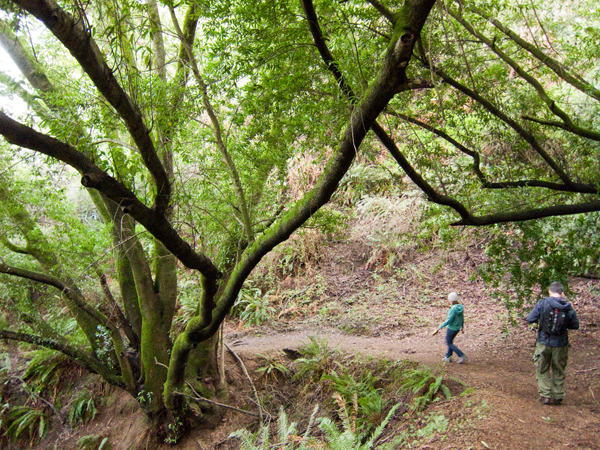
To celebrate the gorgeous weather this weekend, friends and I went hiking in the hills of Oakland at the Huckleberry Botanic Regional Preserve. For those who don’t know it, this is one of the smaller parks in East Bay Regional Park system, consisting of approximately 240 acres (compare that with Redwood Regional Park’s more than 1800 acres)… but what it lacks in size, it makes up for in distinctive character.

As you may have guessed from its name – Botanic Preservethe park hosts a unique native plant community found nowhere else in the East Bay.

oakland hiking, huckleberry botanic preserve

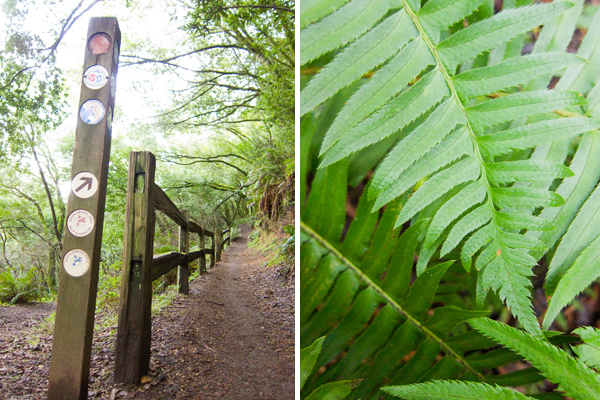
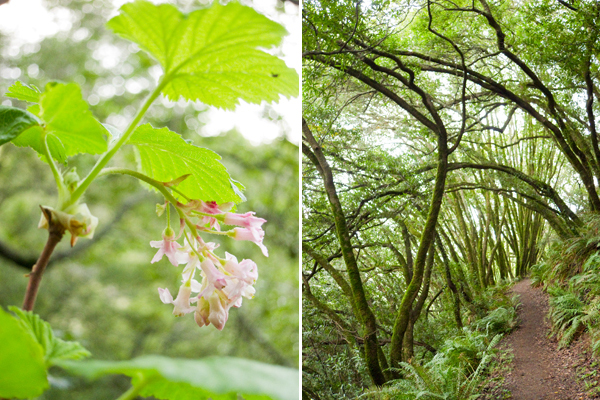
sword fern, huckleberry nature path

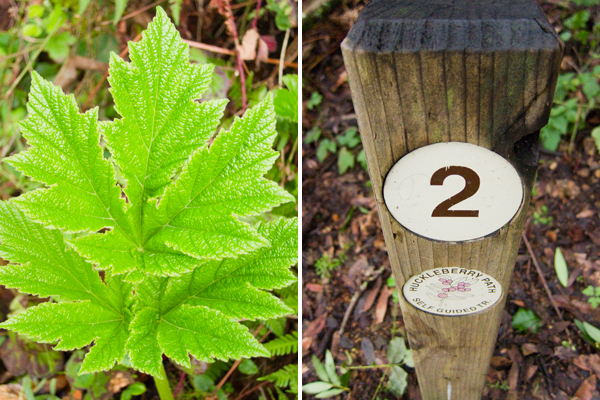
The main hiking trail through Huckleberry is called the Self-Guided Nature Path, which is a well-marked 1.7 mile loop through a variety of terrain displaying the various stages of plant succession that contribute to California’s landscape. The trails are narrow single-track and because of the fragile nature of the preserve, dogs, bicycles, and horses are all prohibited, which makes for a very peaceful hike. Remember to pick up the Self-Guided Nature Path pamphlet at the trailhead if you want to read about the various plants and stages of ecological development at each numbered marker.

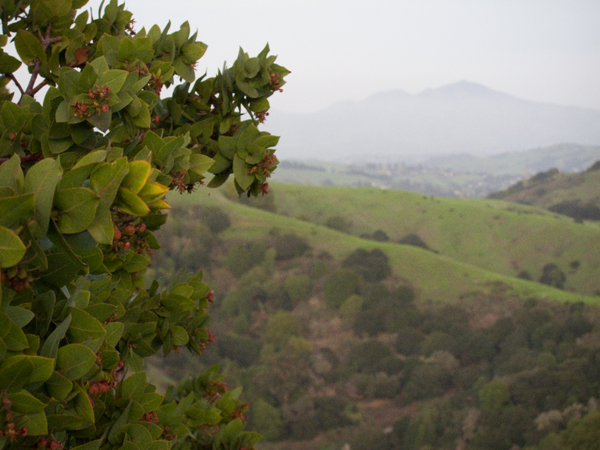
The earliest stages of plant succession have their roots (pun intended) in the rocky nutritionally poor soil found in portions of this park. These areas were laid down as part of the ocean floor millions of years ago, comprised of bands of shale interspersed with the skeletal remains of early marine creatures. Eventually uplifted and exposed due to erosion, the soil has a gravelly texture, poor water holding capacity, and low nutrient values. Sounds bleak, right? Not really. The fractured bedrock below the service holds water for deeper roots while the top layers provide excellent drainage, which happens to be the perfect environment for our shrubby chaparral species such as manzanita, including the rare and endangered Alameda Manzanita.

spring has sprung, oakland hiking trail

Additional moisture is obtained from winter rains and summer fog (as the park is located due east of the Golden Gate), and the north facing slopes are shaded from late afternoon sun. These cool moist conditions contribute to the evolutionary process of succession, where “plant species thrive for a time, but are gradually replaced by other species. In this way, the manzanitas eventually surrender and succumb to other species such as huckleberry, silktassel, and chinquapin. All this time, leaf and branch litter is deposited in greater quantities, soil development becomes richer and deeper, and each succeeding species’ leaf canopy continues to develop upward, eventually shading over and killing the previous species. Over a long period of time, this successional development will inevitably progress toward oak/bay forest [see picture below, right side]” (Huckleberry Self-Guided Nature Path brochure)

Pink flowering currant, huckleberry botanic regional preserve

Another unique feature of this park is its year-round display of plants in bloom. Right now you can see the pink flowering currants (pictured above), among others.

Mt. Diablo, Huckleberry Park

And the small side trail to markers 8-9-10 offers a lovely lookout on Mt. Diablo (pictured above). Did you know there was an effort underway to rename it Mt. Reagan? I am happy to report, however, that the Contra Costa Board of Supervisors recently decided against it (article here). Despite the fact that a Christian zealot thought it profane to refer to it as “the devil,” a large number of supporters, including residents and community organizations, voiced their opinions to keep the name intact. Thank God. 😉

Dig Cooperative at the Oakland Youth Center

Well… you wouldn’t know it by the late hour of this Monday post, but I worked ALL weekend.  Yes indeed…  I’ve been a busy little bee and I’m excited about a lot of the upcoming posts.  So please stay tuned…

As I mentioned last week, folks are gearing up over at the Oakland Green Youth Media & Arts Center for their big grand opening this week… Thursday, January 14th.  It’s been a whirlwind of activity over there, and even though I’m late jumping on the bandwagon (they’ve been working for literally years to achieve the realization of this center), I won’t be shy about singing their praises.

Thursday of last week was a big day.  Not only did the mural project I’m documenting get underway (Spoiler Alert:  I’m making my first movie!), but a large crew of volunteers, headed up by Tondre of Oakland organization DIG Cooperative, worked furiously to install a community garden behind the Center.
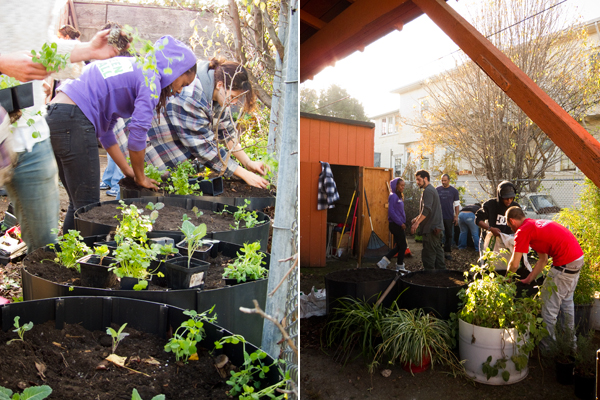
urban garden, oakland youth center garden

The focus of DIG Cooperative is all about water… water-smart homes and water-smart gardens. While speaking to a completely engrossed audience of Oakland youth, Tondre discussed the need for water-wise behavior moving into the future, given that we live in a region whose population is expected to double before then end of the next century.

“The number of people are going to double. But the amount of water is going to stay the same.”

He discussed the healing benefits of green space… the need for a place of peace and quiet, a respite from the onslaught of sensory noise we are subjected to every day in our urban environment. The garden will also contain a sacred altar space to commemorate all of the fallen youth of Oakland, victims of violence.
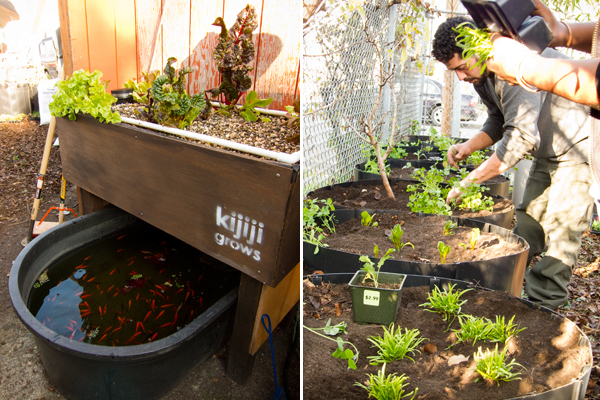
urban garden, oakland youth center garden

What’s amazing about this garden is how much they are accomplishing in an exceedingly small space. In fact, the entire garden is installed on top of concrete/asphalt in what was once, presumably, a small parking area. I love this. I had to resort to the same sort of creativity in creating a sidewalk garden in my concrete surrounded home in West Oakland… I used recycled wood crates and boxes from Urban Ore as large planters on top of the sidewalk. The Youth Center has set things up similarly with raised beds built out of wood, and even simpler “instant” pop-up planter beds made out of re-purposed plastic bamboo root barrier systems. Genius.

Additionally the garden makes use of aquaponic gardening (a union of aquaculture and hydroponics) through the assistance of Kijiji Grows, a collaborative group of farmers, artists, engineers, builders and educators working to change Bay Area lives through urban sustainable growing systems in schools, homes and businesses. Aquaponics is especially effective in areas with little space or access to healthy soil… the plants are grown without soil, utilizing the organic fertilizer produced by the fish (fish poop!), with minimal water usage, and absolutely no pesticides.  Kijiji’s aquaponic kits make great classroom laboratories, useful for demonstrating principles of math, science, technology, and critical thinking.  They believe their greatest impact can be made in teaching the next generation to be good stewards of the Earth.

The garden installed last week is considered Phase I, and there are extensive plans for Phase II to be accomplished throughout 2010. These include rain catchment and gray water recycling systems, removing the asphalt/concrete and establishing plants in the ground that will repair the health of the soil.