Category Archives: political art

The rise of a black middle class…

I took a city walking tour about a week ago in honor of Black History Month… titled “New Era / New Politics” and offered by the city of Oakland free of charge, it’s one of eight walking tours covering different topics in Oakland’s history.  The tours typically only run during summer months from May through October, but this one exclusively is offered three times during February to celebrate the contributions of influential African American leaders to Oakland’s development.  In fact, this tour was developed and first offered in conjunction with the opening of the African American Museum and Library at Oakland (AAMLO) in 2002.  We met on the steps of the AAMLO to begin our tour…

Our guide, Renate, began with a broad statement…  that Oakland, as a medium-sized American city, is unique in its diversity, and specifically its history of diversity. And she attributed this difference primarily to the success of the Pullman Porters.

For those not familiar with the Pullman Porters, a bit of history… In the late 1800’s, Oakland was designated as the western terminus of the Transcontinental Railway.  This railway system connected the eastern portion of the United States with the new western states, and more specifically the burgeoning city of Oakland directly with the more established metropolis of Chicago.  Around this same time, George Pullman, an inventor and entrepeneur based in Chicago, developed railway sleeping cars, designed to offer trans-continental transport in a manner of luxury previously unavailable.  His first cars – containing sleeping berths, curtains, carpeting, upholstered chairs, and washrooms at each end – were called Palace Cars, and were marketed with the motto “luxury for the middle classes.”

To complement this experience of luxury, Pullman exclusively hired African American men to staff his cars as porters and wait-staff, believing that they were well-suited for these positions as “people who had been trained to be the perfect servant[s].” Though the jobs were not particularly well-paying and advancement was limited, they afforded many steady employment and income, as well as the ability to travel… novel concepts for blacks in that day and age in America.  By the 1920’s and 30’s the Pullman Company was one of the largest employers of blacks in America, many of whom lived and worked in West Oakland around the now defunct 16th Street Central Station.

When California joined the ranks of the “united” states in 1850, it did so as a free state with a constitution that abolished slavery.  But despite this, our tour guide Renate informed us that prior to the 1920’s, there were very few blacks in California.  It wasn’t until the railway system was completed and the relative prosperity of the early 20th century offered greater mobility that the first migratory wave of African Americans settled in California, many coming to Oakland in search of greater opportunities.  Throughout our tour, Renate emphasized the differences between this first generation of blacks in the Bay Area, those who had roots in the east and south, and the second generation, their offspring born and raised in California.  The opportunities available to the first generation would be fewer than expected… those coming with hopes of obtaining university educations to establish careers as doctors and lawyers were frustrated to find themselves excluded in ways that had not been expected in the reputedly liberal state of California.

But the Pullman Porters jobs allowed many families to settle in West Oakland… employees were actually required to establish residency within running distance of the train station. These early entrants into the formal blue collar workforce of America took hold of a rung from which they propelled themselves into the mainstream middle class of American Society (Rising From The Rails by Larry Tye).  One of my favorite quotes from the tour was something along the lines of the following:

Once you have an educated middle class,”historical consciousness” comes into being.

With that consciousness, a slew of early black leaders were able to assess the quality and context of their current station in life, and envision a different future possible.  A handful of these visionaries formed the East Bay Negro Historical Society, the remnants of whose archives now form the foundation of AAMLO’s archives.

There is much more to tell, but I am finding it exceedingly difficult to write this from Mexico.  Lo siento.  You can imagine how the gently swaying palms and lapping turquoise waters do distract… Forgive me.

For those interested in delving into this on their own (or too impatient to wait for my vacation-scheduled recap – can you say mañana?), the New Era / New Politics tour will be offered one more time this month… on Saturday the 27th, meets at AAMLO, starts at 10 am.

African American Museum & Library

To commemorate the beginning of Black History Month, I made a visit to the African American Museum & Library on 14th Street, just a couple blocks behind City Center. I have to be honest, and I am ashamed to admit this, but this was my first ever visit to this museum which opened 8 years ago. I guess I’ll just say it was well worth the wait, because it really is a gem of an institution.

First of all, the building itself is absolutely gorgeous! Both an Oakland City Landmark, and listed on the National Register of Historic Places, it’s an architectural delight with lovely arched windows and doorways, detailed exterior stone work and incredible craftsmanship inside.

beautiful oakland building, oakland city landmark

The building was spear-headed by Charles S. Greene, Oakland’s City Librarian from 1889 to 1926, who realized the city was outgrowing its first public library (a wooden structure erected in 1878 where City Hall now stands). He initiated a campaign to build a new one and, along with others including a women’s organization called The Ebell Society, found funding assistance from Andrew Carnegie’s Foundation, which offered $50,000 for the construction of the building. It was designed by architects Bliss and Faville in the American Beaux Arts style, and served as Oakland’s main library from 1902 until 1951.

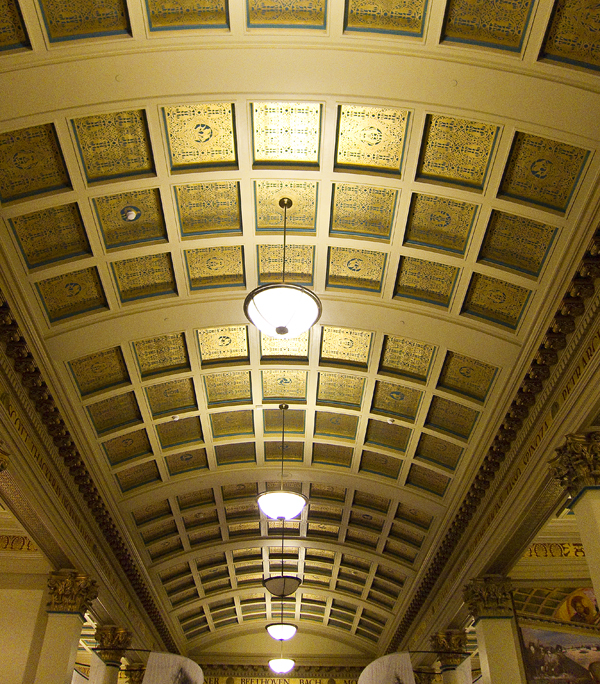
“The elegant exterior of tan brick and terra cotta is incised with names of authors and disciplines and “Oakland Public Library.” “Free to All” is inscribed above the main entrance. The interior exhibits elaborate oak paneling, classical columns, and ornamented plaster ceilings. The second floor with its coffered, barrel-vaulted ceiling supported by massive columns, is one of Oakland’s most imposing interior spaces.” [Historical Plaque co-sponsored by Oakland Heritage Alliance]

barrel-vaulted ceiling

Once the new main library (at 14th and Oak streets) was opened in 1951, this building served as a branch library, at which point it was renamed the Charles S. Greene Library. It later became city offices, and was eventually abandoned after the Loma Prieta earthquake in 1989. “Following extensive restoration, it reopened in 2002 as the new home of the African American Museum and Library at Oakland.”

The mission of the Museum & Library is to discover, preserve, interpret and share the historical and cultural experiences of African Americans in California and the West for present and future generations.

The library is housed downstairs and consists of unique archives and reference materials on the history of African Americans in Northern California. The reference library houses approximately 12,000 volumes whose subjects include “religion, the military, Martin Luther King Jr., Malcolm X, the Black Panther Party, Africa in relationship to the African-American experience, genealogy, and California history.” And the archives contain diaries of prominent African Americans, newspapers on microfilm, videos and oral histories, and much more.

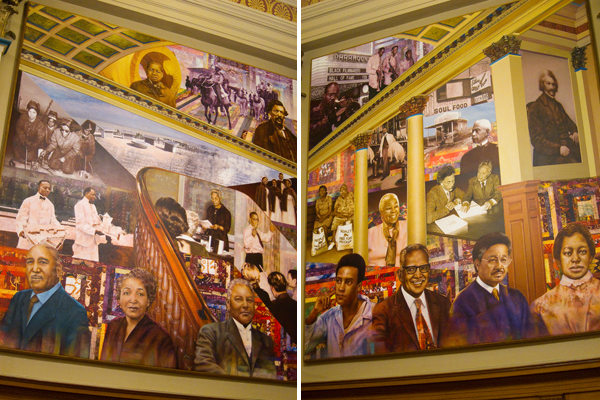
The museum is upstairs and “regularly hosts traveling and original exhibitions that highlight the art, history and culture of African Americans.” Here are two of the murals that greet you as you take the stairs to the second floor…

oakland murals, african american history, african american mural art

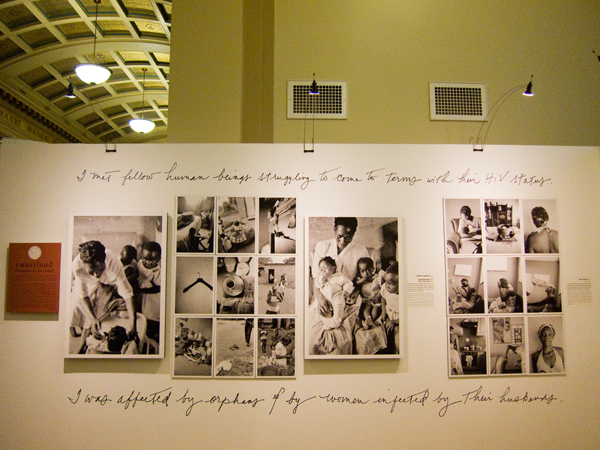
The current temporary exhibit is titled Access to Life: Faces from a Quiet Revolution and will be up through February 27th. It’s a powerful photographic exhibit by 8 Magnum photographers who focus their lenses on AIDS patients both before and for months following their antiretroviral treatments. “The project documents individuals in Haiti, Mali, Peru, Russia, Rwanda, South Africa, Swaziland, and Vietnam; countries chosen because of the diverse contexts and circumstances driving the epidemic in each one.” To learn more, visit accesstolife.theglobalfund.org. Here are a couple shots…

Access to Life, African American Museum

Access to Life, African American Museum, AIDS photo essays

There is also a permanent multi-media installation titled Visions Toward Tomorrow: The African American Community in Oakland, 1890-1990.Visions documents the historical accomplishments of generations of African Americans in Oakland from the era of pioneering and settlement to those eras of community formation, development of the press, establishment of local churches, and creation of a lasting legacy of music and the arts.”

If you’ve never visited this wonderful institution, might I suggest that there is no time like the present. In honor of Black History Month, I plan to focus on more African American cultural events and institutions as February continues…

Words about Oakland….

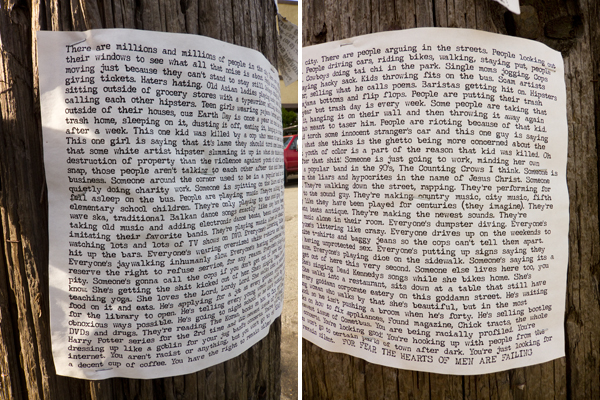
Here is a piece of writing I found slapped up on a telephone poll near Hove’s blue trees mural from Monday.  I didn’t have time to read it all that day, but I took these photos…

telephone pole, story on telephone pole, writing

It’s about Oakland. Here is the text in its entirety… typed to match original as closely as possible. It’s interesting. It’s even more interesting that someone left it on a random telephone pole on Peralta street… it is unsigned. (correction… signed by “FOR FEAR THE HEARTS OF MEN ARE FAILING”… a fantastic psuedonym.) Thanks for sharing your work.

There are millions and millions of people in the city.  There are people arguing in the streets.  People looking out their windows to see what all that noise is about.  People driving their cars, riding bikes, walking, staying put, people moving just because they can’t stand to stay still.  Cowboys doing tai chi in the park.  Single moms jogging.  Cops giving tickets.  Haters hating.  Old Asian ladies playing hacky sack.  Kids throwing fits on the bus.  Scam artists sitting outside of grocery stores with a typewriter, selling what he calls poems.  Baristas getting hit on.  Hipsters calling each other hipsters.  Teen girls wearing pajama bottoms and flip flops.  People are putting their trash outside of their houses, cuz Earth Day is once a year but trash day is every week.  Some people are taking that trash home, sleeping on it, dusting it off, eating it, hanging it on their wall and then throwing it away again after a week.  This one kid was killed by a cop who meant to taser him.  People are rioting because of that kid.  This one girl is saying that it’s lame they should torch some innocent stranger’s car and this one guy is saying that some white artist hipster slumming it up in what she thinks is the ghetto being more concerned about the destruction of property than the violence against youth of color is a part of the reason that kid was killed.  Oh snap, those people aren’t talking to each other after that shit!  Someone is just going to work, minding her own business.  Someone around the corner used to be in a popular band in the 90’s, The Counting Crows I think.  Someone is quietly doing charity work. Someone is spitting on the liars and hypocrites in the name of Jesus Christ.  Someone fell asleep on the bus.  People are playing music.  They’re walking down the street, rapping.  They’re performing for elementary school children.  They’re only playing to the sound guy.  They’re making country music, city music, fifth wave ska, traditional Balkan dance songs exactly like they have been played for centuries (they imagine).  They’re taking old music and adding electronic dance beats, beats antique.  They’re making the newest sounds.  They’re imitating their favorite bands.  They’re playing music alone in their room.  Everyone’s dumpster diving.  Everyone’s watching lots and lots of TV shows on DVD.  Everyone’s littering like crazy.  Everyone drives up on the weekends to hit up the bars.  Everyone’s wearing oversized white t-shirts and baggy jeans so the cops can’t tell them apart.  Everyone’s jaywalking inhumanly slow.  Everyone’s having unprotected sex.  Everyone’s putting up signs saying they reserve the right to refuse service, for any reason.  Everyone’s playing dice on the sidewalk.  Someone’s saying its a pity.  Someone’s gonna call the cops if you don’t get out of here this very second.  Someone else lives here too, you know.  She’s getting the shit kicked out of her.  She’s singing the Dead Kennedys songs while she bikes home.  She’s teaching yoga.  She loves the Lord, Lordy Lord.  She walks into a restaurant, sits down at a table that still have food on it and eats.  He’s applying for a job at every goddamn corporate eatery on this goddamn street.  He’s waiting for the library to open.  He’s telling every young woman who walks by that she’s beautiful, but in the most obnoxious ways possible.  He’s going to night school so he isn’t pushing a broom when he’s forty.  He’s selling bootleg DVDs and drugs.  They’re reading the Koran, books on how to fix appliances, Found magazine, Chick tracts, the whole Harry Potter series for the 2rd time and the newest issue of Cometbus.  You are being racially profiled.  You’re dressing up like a goblin for your jug band’s concerts.  You’re looking good!  You’re hooking up with people from the internet.  You aren’t racist or anything, but you won’t go to certain parts of town after dark.  You’re just looking for a decent cup of coffee.  You have the right to remain silent.  FOR FEAR THE HEARTS OF MEN ARE FAILING

A New Year…

I was hoping for some inspiration for my first post of 2010… a new year, and a new decade. But alas, the inspiration was elusive.

I thought maybe I’d come up with some top ten lists to share (because afterall, people love top ten lists), or simply some sage words… a mantra for our city and its people for the coming year(s), but nothing offered itself.

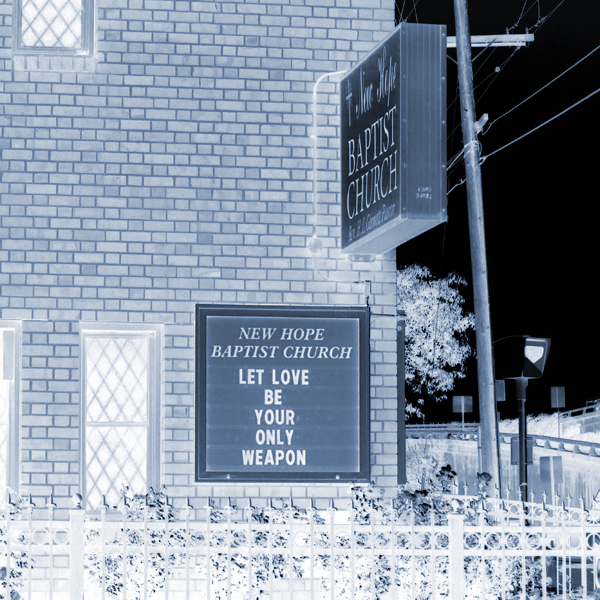
I decided to look back through photos I’ve compiled over the past few months, for something appropriate… something positive, something meaningful.  And I was struck by this message on a local church not far from my home… it fit the bill perfectly.

west oakland baptist church, church sign, church message

When I think back about the past year and the changes I’ve seen in this city I love, I’m aware of a plethora of positive developments, many of which I’ve tried to highlight with the creation of this blog. But I’m also nagged by the awareness that Oakland made headlines across the nation last year, not for the amazing revitalization projects underway in our uptown/downtown districts or the burgeoning and bridge-worthy art & restaurant scenes, but for the senseless murder of an unarmed man on New Year’s Day (Oscar Grant), and the subsequent killing of four police officers in March.

Oakland typically ranks in the top ten most dangerous cities in America; ranked number five in 2008/09 and number three in 2009/10 in the oft quoted annual editions of Kathleen O’Leary Morgan’s City Crime Rankings.  And though current statistics seem to indicate an overall drop in the crime rate for 2009 (Data: Oakland crime down 10 percent in 2009 by Kelly Rayburn), there’s no denying that there is still far too much crime in Oakland. I witness it personally in my corner of West Oakland… the sound of gunfire no longer fazing me as it once did. And that is a sad statement indeed.

I know it is a complex problem. We live in one of the most racially diverse cities in America. I see this diversity as an incredible asset… it’s one of the things I truly love about Oakland. But I am aware that with it, too, comes conflict, especially where social inequities exist… the result of failing families, failing schools, and more. It’s hard to blame some in my community for making a living selling crack, when they lack the skills or education for much else. But there’s no denying that this way of life brings violence and tragedy, not just to those immediately involved, but those nearby as well.

My hope for our great city is that as it grows into the 21st century, it will better serve all of its residents, not just those who can afford homes in exclusive neighborhoods or private educations for their children… gentrification no longer displacing those with the least means, but better development that benefits everyone. This may sound lofty or naive, but I believe it can happen. At least that is my hope. Because in a region rife with affluence, it’s amazing to me how many in our city have so little.