Category Archives: political art

Words By Roads ~ part III

“Art is inseparable from life.” ~ Seyed Alavi

words by roads, word murals oakland, Seyed Alavi murals

Seyed Alavi, words by roads, giant word murals, east oakland murals

This is a continuation from yesterday’s post eRACISM

KQED did a wonderful feature on Seyed Alavi in a recent edition of Spark. Not only does Alavi discuss the creation of these murals (one of his first public art projects), explaining of this one, “You need to put your ‘I’ in [this world] to make a difference,” but he also discusses several others including his Emeryville project Signs of the Times, also a collaborative effort with local students.

Anyone who’s been to Emeryville has undoubtedly seen the striking yellow and black utility boxes featuring manipulated stick figures in unusual, comical, or paradoxical positions… one figure has a jigsaw puzzle piece for a head, one juggles three bowling ball heads, one kneels in front of a giant question mark, etc. I have always loved this project but never knew who was responsible for these clever and thought-provoking images until watching this episode…

If you have the time to watch the full episode, a recent project done for the Exploratorium in San Francisco is featured at the end, and it’s simply fascinating. The piece explores the concept of liminality – “a psychological, neurological, or metaphysical subjective, conscious state of being on the ‘threshold’ of or between two different existential planes.” (Wikipedia) Talk about deep.

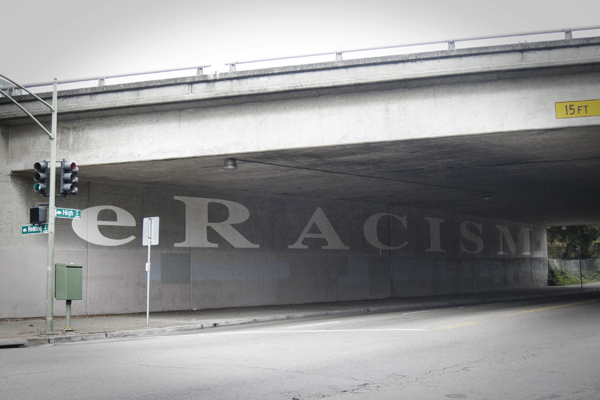
eRACISM

One of a series of murals featured under various 580 freeway exits in East Oakland. My favorite of the series (Park Blvd exit) was featured awhile back… Invisible Colors.

This one’s my next favorite and is located at the High Street exit…

fruitvale exit mural, word murals oakland, eracism mural, east oakland freeway murals

There are four in total from a project titled Words by Roads which was commissioned through the City of Oakland’s Public Art Program in 1991.

Directed by Iranian born conceptual artist Seyed Alavi, the artworks were created in collaboration with sixteen students from Skyline, Fremont, and Oakland High Schools.

Alavi, who’s known for the use of language in his works, conducted creative workshops with the students “to communicate ideas about the power of language… and the social and cultural nature of public art.”

He saw himself acting merely as a facilitator and credits the ideas and sketches for the murals exclusively to the students. “These students felt racism was the most important issue to comment on and decided on four phrases… to be printed on highly visible locations in their neighborhoods.” (City of Oakland Public Art Program)

You’ll have to check back to see the others…  I’ll have more info on the artist too.

fruitvale avenue, word murals oakland, fruitvale eracism mural

Coming of Age in California…

More than 40 years after Anne Moody’s autobiography Coming of Age in Mississippi was published, I am amazed to see how far we still have to go in terms of race relations in America. Her book – an intimate portrait of the inequities and violence experienced as a poor, young, southern African American in rural Mississippi and her ultimate involvement in the civil rights movement – ends as she and fellow civil rights advocates ride a bus on their way to Washington D.C.

As riders sing the civil rights anthem “We Shall Overcome,” her fellow rider notices that she is not singing along. He asks, “Moody, we’re gonna git things straight in Washington, huh?” She doesn’t answer but only thinks to herself… I WONDER. I really WONDER.

And 4 decades later I find myself wondering, how is it that in some respects we’ve come so far, while in others we continue to fail so miserably?

As someone who loves the city of Oakland and the amazing state of California (I moved here from the East Coast as a young adult and have never once considered moving back), I was disheartened to see the events that transpired last night. What started off as a largely positive and peaceful protest, orchestrated by local government leaders, non-profits, clergy, citizens, and the like, was ultimately hijacked by a few, clearly hell-bent on destruction despite everyone’s pleas for peace (including the family of Oscar Grant).

I believe it will become clear as the details of these arrests come out, that the majority of these folks are not from Oakland. And the acts they commit, supposedly in the name of justice, are nothing more than senseless vandalism, theft, and destruction. They do not contribute in any way, shape, or form to the promotion of justice.

In fact, some of these horrible acts were committed by perpetrators wearing Oscar Grant masks. How f&*(ing ridiculous is that? As if it hasn’t been painful enough for the family members of Grant, to now have to witness these acts being performed by actors assuming his likeness. It’s the stupidest. StupidEST!

The photos below (borrowed from Oakland Tribune with photo credits and links to original articles) portray this idiocy.

Karl Mondon

This is AMUSEMENT?!? This is not a game people. This is a real community. Blacks, Whites, Browns, Reds, Yellows, hell, Purples, and Greens. WE ALL LIVE HERE!

Noah Berger

Please tell me how stealing shoes from local business owners promotes justice. Anyone?!?

In my opinion, these acts only hurt the cause because they continue to reinforce negative stereotypes. If the shoe fits…
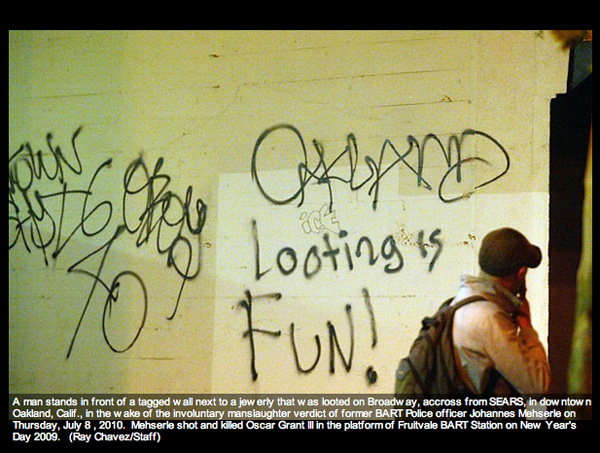
Ray Chavez

FUN??? Again, I’m confounded. Is this about justice or is this about getting your rocks off?

Noah Berger

This weekend marks the 50th anniversary of Harper Lee’s To Kill a Mockingbird, another classic of American Literature devoted to the theme of racial injustice, among others. As the media has highlighted various events going on this week in honor of the anniversary, I couldn’t help but think about the parallels with our current day events…

In To Kill A Mockingbird, a black man is charged with the crime of rape against a white woman. Despite his innocence, he is found guilty by the jury. An unjust verdict.

In the Mehserle trial, a white police officer is charged with the murder of a young, unarmed, black man. Despite the fact that his actions clearly resulted in the death of Grant, he was convicted of only “involuntary” manslaughter, meaning there was no intent.

The trials are very different to be sure, but both involve racially charged situations in which an unjust verdict was reached (or at least what many deem to be unjust, in the current case).

I, for one, plan to re-read To Kill A Mockingbird this weekend in honor of the anniversary, and in light of recent events. Its lessons remind us to treat each other with respect and compassion. To realize “you never really understand a person until you consider things from his point of view — until you climb around in his skin and walk around in it.”

Peace everyone.

Key Route Plaza Mural

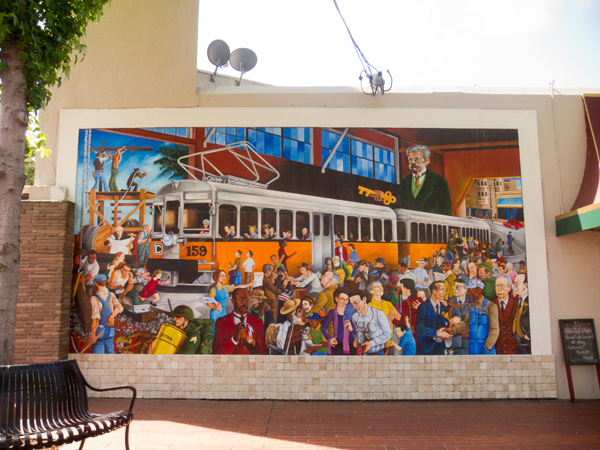
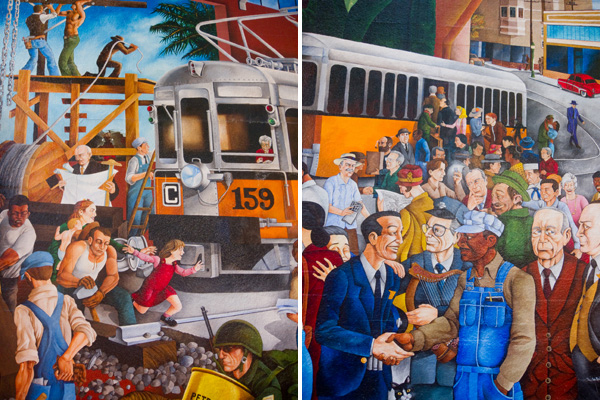
Here’s another mural by artist Rocky Rische-Baird commemorating the history of the Bay Area’s Key Route Train System…

Key Route Plaza, piedmont avenue plaza

Located at Key Route Plaza at the intersection of Piedmont Ave and 41st, the spot marks the site where the first key route electric train arrived in 1904 from a new ferry pier on the bay off Emeryville.  Later in 1937,  a new train station was built here to accommodate new streamlined trains which would run across the Bay Bridge into San Francisco, transporting passengers downtown (1st and Mission) in just 27 minutes. (historic plaque)

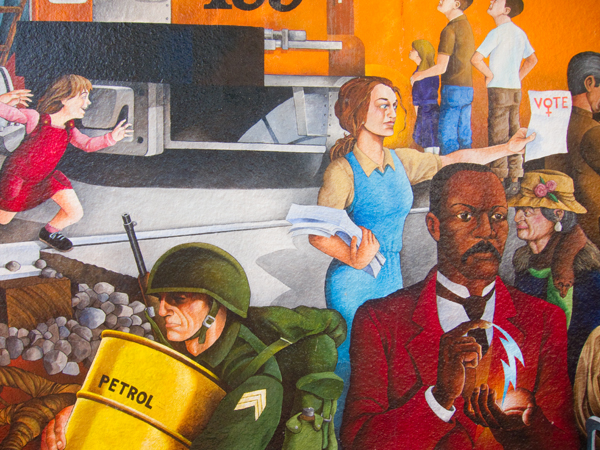
The mural is full of symbolism, and as guest commenter Oakland Daily Photo pointed out, this one is significantly more political that the downtown version featured yesterday.  In just one section of the mural we can see figures representing Black Power, Women’s Suffrage, and our country’s military might linked to our need for petroleum.

rocky rische-baird, key route plaza, key route station piedmont ave

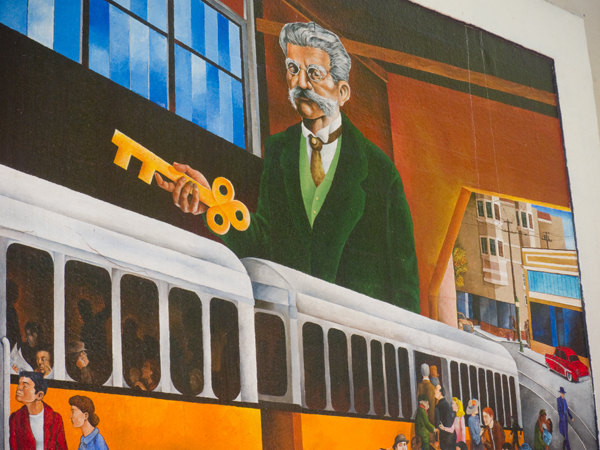
The primary figure in the upper right-hand corner, Francis Marion Smith
(known as “Borax” Smith for the riches he acquired in mining borax in Nevada), was the visionary behind the Key Route System.  The key he is holding “has three rings at its handle to symbolize the three lines to Berkeley, Oakland and Piedmont. The long stem represents the Key Pier, which carried trains about 3 miles over the bay, and the teeth represent the ferry slip.”

Borax Smith, Key Route System visionary

Artist Rische-Baird raised money for the production of the mural by literally selling the seats on the train.  Passengers portrayed in the windows are real live residents who contributed funds, some who actually rode the train system before its last run in 1958.

Borax Smith, Francis Marion Smith, key route mural

Much of this information and more about the artist and the production of the mural can be found in this article:  Key to the Past / A Piedmont mural captures the glory of a bygone transit system by Sam Whiting.

rocky rische-baird, key route mural

key route plaza, key route station history